The Decluttering Rule That Sends Useful Things Away
A better decluttering rule weighs an item's purpose, storage cost, and likely future use so useful household gear does not leave just because it sat unused.
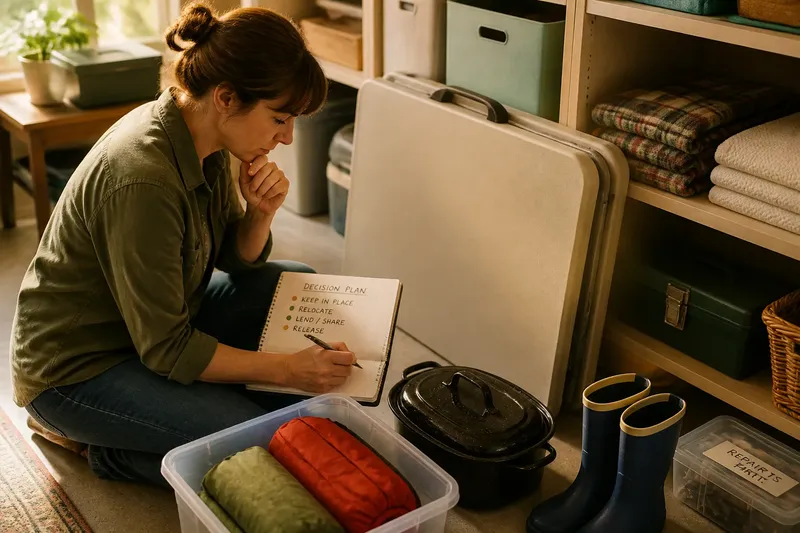
That folding table has not left the closet since last spring, but it still earns its space when relatives visit or a neighbor needs a work surface. A decluttering rule based only on recent use can send useful things away; a better decision weighs purpose, storage cost, and likely future use.
Use a week to review belongings in small groups rather than emptying the whole house. The goal is not to defend every object. It is to distinguish something temporarily quiet from something that no longer serves your household, then make a clear plan for each.
Why can an unused item still be useful?
Frequency is only one clue. Some belongings are meant for occasional situations: a roasting pan for a holiday meal, a spare blanket for a guest, a child’s rain boots kept for a younger sibling, or a tool used for a particular repair. Their value lies in being available when the need appears, not in being used every week.
Ask what job the item does, who may need it, and what you would do if it were gone. If there is a realistic answer, the object may deserve a place. If the answer is only “I might need it someday,” look for a specific occasion, person, or task that makes that possibility credible.
Think of storage like a seat on a bus: it is limited, so each occupant should have a reason to be there. A compact set of serving platters may take little room and support gatherings; a bulky broken appliance with no repair plan occupies space without a useful job.
What should you consider before deciding?
Look at three factors together, not in isolation:
- Purpose: Name the task, event, or person the item serves. “For occasional guests” is clearer than “might come in handy.”
- Storage cost: Consider the room it takes, whether it blocks access, and whether it needs special care. A large object stored in a damp basement may cost more attention than a small one on an accessible shelf.
- Likely future use: Identify a plausible time or circumstance. Consider season, household changes, scheduled projects, and whether you already own a substitute.
Then compare that purpose with the item’s condition. A sound tent that fits an upcoming family trip is different from a tent with a torn floor and no repair intention. Be honest about the work required, too: “I will mend it” is useful only if you can name when and how, or arrange for someone qualified to do it.
Local donation policies, product labels, and manufacturer instructions can matter for certain items, so check those before passing along anything with specific handling or use requirements.
How can you review belongings over a week?
Choose one small category each day and set aside a short, manageable window. Keep a notebook or a note on your phone with four destinations: keep in place, relocate, lend or share, and release. Avoid spreading belongings across rooms; a contained review is easier to finish and less likely to disrupt daily routines.
- Day one: Pick a category. Choose one shelf, a single drawer, or one type of item, such as baking pans. Leave the rest of the room alone.
- Day two: Name each item’s job. Write a few words beside anything you are unsure about: “school project,” “guest bedding,” or “winter outage supplies.” An unnamed purpose is a prompt to investigate, not an automatic reason to discard.
- Day three: Check access and condition. Notice what is hard to reach, damaged, incomplete, or duplicated. Keep a useful item where you can retrieve it, and separate anything that needs repair or a missing part.
- Day four: Consider the calendar. Check the coming season and any household plans already on the calendar. If a possible use has no likely occasion, decide whether the item is worth storing without pretending that use is imminent.
- Day five: Choose a destination. Put keepers back in a labeled, sensible location; move misplaced belongings to the room where they serve; and make a specific plan for lending, sharing, or releasing the rest.
For an item you cannot judge in the moment, write down what would make the decision clear: a repair quote, a conversation with the person who might use it, or a look at the next season’s plans. Give that question a date to revisit. Without a prompt and a review point, a “maybe” box can become permanent storage.
What if the future use is possible but uncertain?
Separate a plausible need from a vague fear of being caught unprepared. A spare can be sensible if it supports a known household routine, is difficult to borrow when needed, or replaces something that is routinely shared. A second version of an item deserves closer scrutiny when it duplicates something easy to access.
Say you find a sturdy folding table in the garage and have not used it since a family gathering. You have another gathering planned, and the table folds flat against a wall. Keeping it in that designated spot has a clear purpose and low storage cost. If the gatherings have stopped, the table is awkward to move, and a neighbor already has one available to borrow, sharing or releasing it may make more sense.
For seasonal gear, give it a home near the season’s other supplies and review it when that season ends. For an item connected to a project, note the project rather than treating every imagined future project as a reason to keep equipment indefinitely.
How do you decide whether storage costs too much?
Storage cost is more than the footprint. An object may make a useful closet shelf inaccessible, require careful upkeep, or be so difficult to retrieve that you would borrow or buy another rather than use it. On the other hand, a small item kept in a labeled bin may be easy to store and valuable when needed.
Try moving likely keepers to a practical location before deciding. Can you reach them without shifting unrelated belongings? Are parts together? Would a clear label help another household member find them? If the answer is no, the issue may be placement rather than the item itself. If making room would displace something you use more often, compare the two purposes directly.
Which questions help settle a difficult decision?
Should I keep something I use only once a year?
Possibly, if that yearly occasion is real, the item works, and storing it does not interfere with more useful belongings. Put it with the supplies for that occasion so its purpose remains visible.
What if I can borrow the item instead?
Consider how easy borrowing would be, whether the owner is comfortable lending it, and whether the timing is predictable. If borrowing is straightforward, keeping a duplicate may not be worth its storage cost.
How long should I keep an item in a maybe pile?
Keep the undecided group small and attach a review date to it. Before that date, check the specific condition you wrote down; if it never becomes relevant, choose a destination rather than extending the pause by default.
What should I do with a useful item I do not need?
Offer it to a particular person or group that can use it, or check whether a local reuse organization accepts that kind of item. If nobody wants it or it is not fit for use, choose an appropriate disposal route instead of passing along a problem.
How can you make the decision last?
When you keep something, record its job in a short label or a household note: “extra chairs for guests” or “repair kit for the garden hose.” Store related items together, and avoid hiding occasional-use supplies behind things used every day. A clear home makes it easier to tell whether you have a useful reserve or a forgotten duplicate.
When you release something, finish the handoff: contact the intended recipient, schedule a drop-off, or place the item in the right collection. A decision left in a hallway is not yet a change in the household. For belongings that remain useful but are needed only by turns, offer a lending arrangement with a simple return plan.
Use the same review when the season changes or a household routine shifts, but do not reopen every decision without a reason. A sound decluttering rule treats recent use as evidence, not a verdict. When the purpose is clear, storage is manageable, and future use has a believable place in your life, keeping an item can be the more resourceful choice.